
Wetlands are among the most efficient natural carbon sinks on Earth, yet their role in climate mitigation remains one of their least visible ecosystem services. Their capacity to capture, store and release carbon is far from static: it changes over time and varies across different habitats, depending on hydrology, vegetation, water quality and human management.
Within the Wetland4Change project, Lake Kerkini became the first Greek wetland where the carbon balance was assessed through a comprehensive field-based approach. The research provides new evidence on how Mediterranean wetlands contribute to greenhouse gas regulation, while also revealing the ecological complexity behind carbon dynamics and the importance of maintaining healthy hydrological conditions.
In this interview, Anastasia Chatzimentor from the Greek Biotope/Wetland Centre (EKBY) explains why wetlands should be considered essential allies in climate action, how carbon sequestration is closely linked to ecosystem integrity, and how these scientific findings can support future land and water management strategies at both local and national levels.
This project represents the first attempt to quantify carbon balance in a Greek wetland ecosystem. What are the most significant findings regarding Lake Kerkini’s capacity to function as a carbon sink?
One of the most important outcomes of our research is that it highlighted a key but often overlooked function of wetlands: carbon sequestration and the maintenance of a dynamic, seasonally variable carbon balance. When this function is disrupted, the capacity of wetlands to contribute to greenhouse gas mitigation is negatively affected. It is a regulating ecosystem function that remains largely invisible to people, yet it silently performs a crucial role. In this sense, our findings provide an additional strong argument for the conservation and protection of wetlands.

Anastasia Chatzimentor – EKBY
Our observations throughout the annual cycle highlight hydrology as one of the most critical factors determining carbon balance in the lake, mediated through primary productivity. Different photosynthetic organisms — including phytoplankton, aquatic macrophytes, and wet grassland vegetation — can shift the balance of gas exchange towards net carbon uptake. Therefore, maintaining and improving hydrological stability in the lake (avoiding abrupt or extreme fluctuations in water level) as well as preserving favorable conditions for aquatic vegetation (such as good water transparency and the prevention of eutrophication) are among the main priorities for safeguarding the lake’s capacity to maintain this carbon balance. Importantly, these priorities are not entirely new insights for Lake Kerkini; they already form the core of the management interventions proposed by the Protected Areas Management Unit.
Lake Kerkini remains a relatively low-disturbance lake, characterized by mild human activities such as grazing, small-scale ecotourism facilities, and limited construction. However, it plays a major role in flood protection and irrigation for the Serres plain, and this constitutes the greatest pressure exerted on the ecosystem. These pressures ultimately influence the full range of the lake’s ecological functions, from biodiversity conservation to the regulation of greenhouse gas dynamics.
Your findings show that different parts of the wetland can function both as carbon sinks and carbon sources. What does this reveal about the ecological complexity of wetlands?
One of the first challenges we encountered in this work was the complexity of Lake Kerkini itself — an artificial lake that nevertheless functions with the ecological “radiance” of a Ramsar wetland. This complexity is reflected in the diversity of habitats within the lake, the variety of human activities connected to it, and the multiple ecological and social roles it performs.
The patterns we observed in our field measurements follow the broader seasonal and spatial heterogeneity of the lake ecosystem. Change is an inherent characteristic of ecosystems and is closely linked to their resilience and adaptive capacity. This variability is part of a natural ecological heterogeneity.
For example, our measurements showed that even the deeper parts of the lake can temporarily shift into net emission sources during winter, due to very limited photosynthetic activity. However, during the rest of the year, in permanently inundated areas — both shallow and deep — CO2 uptake generally exceeds emissions.
At the same time, spatial heterogeneity also plays a major role. We observed that seasonally flooded areas and temporary ponds often function as important emission hotspots, despite being areas of exceptionally high biodiversity value. These zones are exposed to disturbances such as wave action, sediment resuspension, and increased exposure to atmospheric oxygen, conditions that favor CO2 production over uptake. A similar pattern was observed for methane, as seasonally flooded areas and temporary ponds act as methane emission hotspots. Yet these same areas support highly complex food webs because they host a diversity of metabolic processes that sustain biological productivity. They provide critical feeding, breeding, and overwintering habitats for a wide range of organisms, from birds that depend on shallow zones for foraging, to fish that use them for spawning. Because these habitats are exposed to continuously changing environmental conditions, they can support heterogeneous biological communities adapted to different ecological states. This diversity of life and ecological functions is reflected in the intense biological activity they sustain.
Therefore, the mosaic of greenhouse gas exchanges — including both net sequestration and net emissions — emerges directly from the spatial and temporal biological and environmental heterogeneity of lake ecosystems. We should not interpret seasonally flooded areas or temporary ponds as “harmful” simply because they emit higher amounts of greenhouse gases, since these emissions are closely linked to the ecological conditions that allow these habitats to perform essential ecosystem functions. What is important is to understand where human intervention disrupts or destabilizes this natural ecological functioning — for example through abrupt and extreme water-level fluctuations caused by flood-control or irrigation management. For this reason, we are currently working on different water-level management scenarios for the lake, in order to better understand how anthropogenic hydrological alterations affect this important regulating ecosystem function.
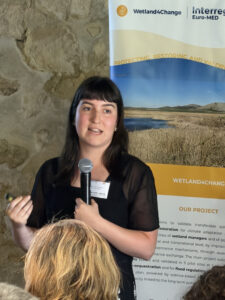
Anastasia Chatzimentor EKBY
Based on your results, what role should Lake Kerkini play within Greece’s national strategy for climate neutrality and the broader European Green Deal?
A meaningful climate-oriented approach to wetland management is not limited to the reduction of emissions, but is fundamentally concerned with maintaining the ecological integrity of wetlands through policies that shape water management, agriculture, and land use. Safeguarding as much as possible the natural hydrological regime of the wetland, and ensuring appropriate environmental conditions (such as water transparency, nutrient balance and inputs, the avoidance of abrupt hydrological fluctuations driven by coastal activities, and the preservation of wet meadows and reed beds), constitutes the core of a climate-responsible stance towards wetlands.

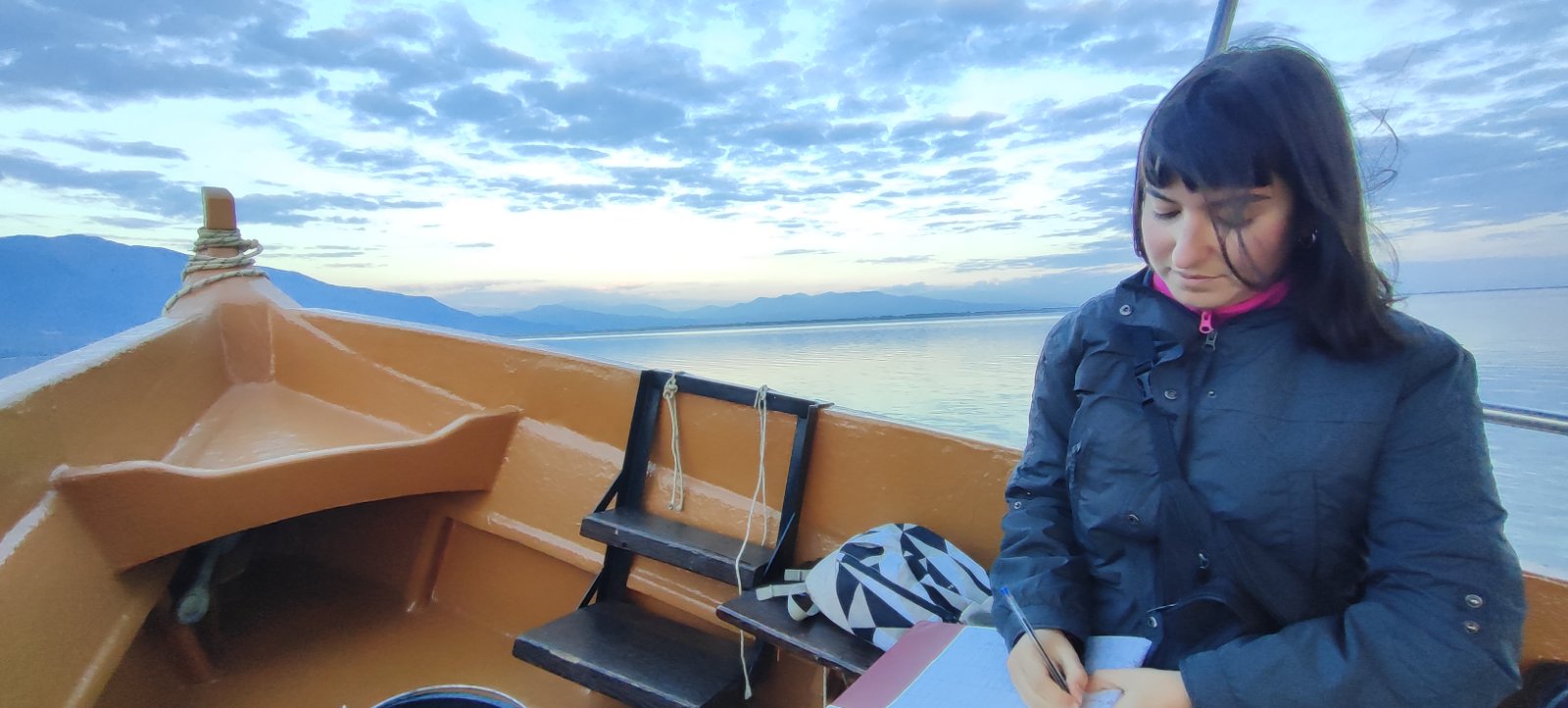
Anastasia Chatzimentor with gas analyser in Lake Kerkini – Wetland4Change
Lake Kerkini, along with other wetlands across the country, represents a shared common resource whose conservation can significantly contribute both to climate change adaptation and to mitigation efforts. This requires collaboration and coordination with other policy domains, which must integrate the climate dimension in a just and decisive manner, and incorporate nature-based solutions grounded in an ecosystem-based approach. Our findings need to be synergistically linked with policies that regulate land use in wetland ecosystems and their wider catchments, such as the Common Agricultural Policy, River Basin Management Plans, Flood Risk Management Plans, Spatial Planning, and municipal-level measures. The key contribution of Lake Kerkini to a national climate strategy lies in demonstrating that conservation of wetlands as carbon sinks is simultaneously a matter of water management, land use, biodiversity protection, and the social governance of common resources.
Although the twentieth-century threat of large-scale wetland drainage (e.g. Lake Karla, Lake Giannitsa, Lake Achinos) is no longer predominant, the defining challenge of the twenty-first century is water demand and water accessibility. There is increasing demand for irrigation, industry, and domestic water supply, while climate change intensifies both drought conditions in lakes and competition across all water uses. In water management, there is a risk that lakes are treated merely as water reservoirs, a perspective that can jeopardize the ecosystem integrity and biodiversity supported, as illustrated by the loss of riparian forests (e.g. riparian forest of Strymonas River in Kerkini). Similarly, excessive water extraction may transform wetlands into degraded reed-dominated landscapes. Addressing this challenge requires cooperation and the inclusion of diverse stakeholder groups using the lake, along with innovations in water-use efficiency to ensure the long-term sustainability of these shared resources. Lake Kerkini serves as an excellent example of how the carbon balance of a wetland can be translated into actions related to land use, landscape management, and property regimes. This does not only concern the restoration of a disrupted ecological equilibrium, but also the long-term maintenance of an already existing but fragile balance. For instance, this includes the protection of the agroforestry landscape surrounding Lake Kerkini from the expansion of intensive agriculture.
Looking ahead to 2030, how can these findings be translated into operational practices? What would a concrete model of “carbon-aware land and water management” look like in a context like Kerkini?
Carbon-aware management is not a separate management system. In practice, a carbon-aware management model for wetlands does not concern carbon alone; rather, it primarily concerns the protection of hydrology, vegetation, and land uses that determine the overall ecological functioning of the ecosystem. However, since wetlands are socio-ecological systems, such management cannot be confined to environmental policy alone, but requires the convergence of policies related to water, agriculture, land use, and common resources.
Land and water management is a complex and continuously renegotiated relationship between societies and the common resources they depend on. Particularly under conditions of environmental and climate crisis, this relationship becomes increasingly urgent. Therefore, an ecosystem-based and strategic approach is necessary, grounded in clear national policies and practical coordination and support, while at the same time being complemented by the implementation of good practices and local-scale collaborations. There is no single “carbon-aware” management model; different models can operate in different regions depending on their ecological and social conditions.
The case of Kerkini Lake
In the case of Lake Kerkini, our work already focuses on translating the management recommendations of the Management Authority into their potential climatic and carbon-related impacts, so that this dimension is more meaningfully integrated into lake management, based on the carbon emission factors we have derived from field sampling.
Lake Kerkini in winter – Wetland4Change
At the same time, at the level of agricultural policy, we promote the importance of wetland conservation through the recognition of good practices already implemented by local users, such as grazing and precision agriculture, which contribute to wetland conservation either as carbon sinks (GAEC 2 conditionality) or as elements of biodiversity (GAEC 8 conditionality).
Within the framework of the new Nature Restoration Regulation, we are collaborating with local stakeholders on wetland restoration projects that can simultaneously support traditional activities in the area. In cooperation with ecotourism stakeholders in particular, we aim to highlight not only the lake itself but also the smaller wetlands of the region as living ecosystems with multiple functions and values.
The main challenge and ultimate conclusion of our work is to integrate carbon balance into a broader narrative for the wetlands, one that connects with their wider ecosystem functions and services. Recognizing that climate and carbon research often relies on highly technical and scientific terminology, it becomes useful to translate it into shared concerns that people experience more directly, such as water management, quality of life, or even health. People protect what they understand, not what appears abstract or overly technical/intellectual. Local communities must also be equipped with the tools and arguments to defend the proper functioning of these ecosystems against practices that lead to degradation or unsustainable exploitation of common resources.
Continue exploring Lake Kerkini
Carbon sequestration is only one part of the story. Discover how the Wetland4Change research at Lake Kerkini also explores flooding regulation, governance and climate resilience through complementary scientific assessments and interviews.